Author: Jay VanLandingham

  • The Art of Creative Stillness

    Why Every Story—and Every Soul—Needs Space to Breathe

    It’s official: I’m halfway through the first part of the first draft of my novel.

    For the past five months, I’ve spent every week writing chapters, revising them, and submitting them to my Thursday night critique group. I developed a routine—and fell in love with the book.

    The process felt like being on a train moving down the track with great purpose. Fueled by momentum, I didn’t want to stop. But once I completed the last chapter of Part One (this novel has two parts), I found it hard to slow the train.

    But I knew I had to.

    I had to pause, set the writing aside, and give it time to breathe—to simmer on the back burner. To distance myself from any attachment to the outcome.

    Let me tell you why.

    The Importance of the Pause

    We meditate to get still. We go out in nature to get away from the noise of daily life. In the quiet, we hear ourselves think. We reconnect with our intuition.

    The creative process is no different.

    Stephen King famously puts his first drafts away for six weeks before revising. He works on something else in the meantime, giving his mind the chance to reset. That distance builds perspective.

    I think about how often I’ve had to do the same in life—step away from a situation to see it clearly. The more emotionally attached I am, whether to a story, a relationship, or a decision, the more distance I need in order to gain perspective.

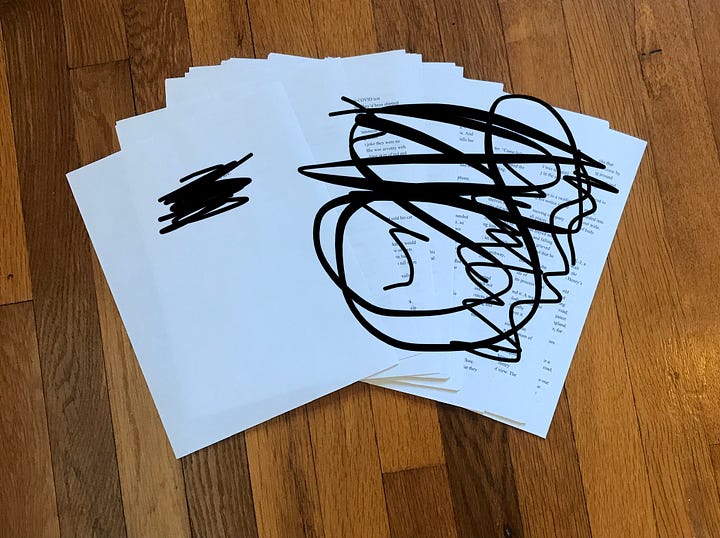
    Thanks to the Hamilton County Public Library’s affordable printing services, I printed my manuscript and tucked it away in an old file cabinet.
    Scribbled manuscript hiding in file cabinet

    And now, I wait.

    Sort of.

    I knew that if I didn’t give myself other projects, I’d go marching right back to the manuscript. My goal is to leave it untouched for a month—out of sight, out of mind.

    In the meantime, I’m happily returning to my Middle Grade series, Animals of Justice (more on that in the future).

    Jay’s Substack is a reader-supported publication. To receive new posts and support my work, consider becoming a free or paid subscriber.

    Do Not Rush the Sacred

    In today’s world, there’s constant pressure to produce—quickly and often. For authors, that can look like rushing a book to publication to keep up with expectations. But slowing down is not only valuable—it’s an act of defiance.

    To slow down is to honor the process. It’s a message to the Muse, to the Universe, that the work is sacred and deserves to unfold in its own time. When we make that choice, we remind ourselves—and the world—that it’s the art that matters most, not the speed of its production.

    Rushing the sacred rarely produces the best results. Authenticity and truth can’t be forced.

    Good art needs time. Stories need time. Like plants, animals, and humans, our creations need space to find their purpose.
    stillness

    No one gets to decide how long the creative process should take—not even me.

    As much as I’d love to hurry up and share this book with you—because I love it, because it feels so relevant—I know that to do so would rob it of its gestation period. It would feel unnatural.

    There’s a difference between what the mind wants and what the soul needs. Creativity comes from the soul, and the soul seeks stillness to feel safe enough to grow.

    Our stories need that too.

    It’s incredible what beauty and discovery can emerge from waiting—from stepping back and allowing perspective to form. Only through detachment can we truly see our work. That clarity is what revision requires.

    In revision, we become both reader and editor. Discernment can’t happen when we’re charging ahead at full speed.

    Stop. Pause. Reflect.

    In time, the story, the art, the relationship, or that decision will reveal itself. All it needs is space—and time—to become what it’s meant to be.

    Jay’s Substack is a reader-supported publication. To receive new posts and support my work, consider becoming a free or paid subscriber.

    Reflection

    What in your life are you trying to rush?

    What could benefit from a little detachment?


    Feel free to leave a comment and stay connected!

    Blog written by guest blogger, Jay VanLandingham

    You can learn more and follow Jay at his website, here.

  • Stronger Together:

    Reflections on Community, Courage, and the Unexpected Magic of Showing Up

    By Guest Contributor, Jay VanLandingham.

    “A rising tide lifts all boats.”
    -John F. Kennedy


    Imaginarium Convention 2025:
    Let me tell you a story about my first writer’s convention. The Imaginarium Convention, which
    takes place every third weekend in July in Louisville, KY:


    DAY ONE
    I arrived at the Holiday Inn on Thursday evening after a two-hour drive from Cincinnati. As soon as I walked in, the rows of tables dressed in black cloth greeted me. I was excited to discover that my table was the very first one people encountered as they entered (or exited) the hotel.
    A man at the booth beside me was in the process of setting up. He introduced himself immediately and told me this was “prime real estate” for our booths. We became instant friends.

    DAY TWO
    The convention officially began at noon on Friday. I had two hours to network and get acclimated before my scheduled workshop. The grand hallway was lined with tables and elaborate decor: steampunk, book displays, creepy clowns, and plenty of cosplay.
    This convention had it all—writers, a film festival, cosplay contests, workshops, panels, and awards. Having never been immersed in the cosplay community, I found it welcoming, open, generous, and full of enigmatic people who could express themselves freely.
    I was in my element.

    I came to this convention with the intention of networking and making new friends. It wasn’t about selling books—it was about
    relationship and community. Writing is an insular experience. And the life of an author can be isolating. Community support is vital to the success of an author, especially for those of us who hope to flourish in this career over the long run. I was pleased to discover that my booth neighbors were queer allies. In my experience, the writing community tends to lean liberal, and these spaces are often queer-friendly. There’s nothing quite as joyful as seeing others in their element—whether dressed head-to-toe in steampunk garb, wearing elven ears, or donning elaborate period costumes. I’d never been part of something quite like this, and this is where the gratitude began.

    This was a weekend of firsts. I gave a workshop titled Writing for Change: Weaving Social Justice into Fiction with Care and Impact. I had a wonderful time talking with participants about writing stories that tackle social justice issues—without becoming preachy. Again, I was in my
    element.

    Immediately after the workshop, someone approached me and said they had worked at Farm Sanctuary and were “good friends” with Gene Baur. Another participant owned a publishing company. His wife ended up buying the entire Sentient series for her son-in-law—serendipitously, he had asked for eco-dystopian fiction for Christmas. And he’s also vegan.


    Connection is everything.
    Later, I sat in on a panel about literary fiction. Honestly, I didn’t feel particularly confident walking in. I’ve written literary fiction—mostly shorter works. Literary fiction was my entry point into writing, twenty years ago during my undergrad at NKU. But the other writers, along with the panel moderator, were kind and down-to-earth. I felt comfortable chiming in and speaking about what I know best—metaphor. By the end of the day, I was having dinner with author friends at a delicious Ethiopian restaurant in Louisville.

    Being surrounded by other writers felt like being home. I don’t know how else to describe it. Maybe it’s the community that’s been cultivated over the twelve years since Imaginarium’s inception, but as one writer put it: “This conference is like family.” You could feel that energy in the room. It was palpable. The more I immersed myself in the weekend, the deeper the kinship I felt—akin to the connection I experience in queer and vegan spaces. A sense that “we are all in this together.”

    Non-competitive. Collaborative. Supportive. Generous.

    DAY THREE
    By Saturday, I felt as much a part of the family as one can after just a few days among strangers. I spent the day chatting with my booth neighbors, who I discovered were members of the Disciples of Christ church. (ASIDE: I belonged to the Disciples of Christ for about twenty
    years—and my mom still does.) I enjoyed the costumes, the networking, and the conversations that seemed random—but
    weren’t. I sold a few books. And because I felt so comfortable—because the community had created this sense that I could do just about anything—I decided, on a whim, to participate in a “Pitch to an Agent” workshop.

    Yep. That’s right. I pitched my new novel to an agent.

    In all my years of dreaming about being an author, one of those dreams included the experience of having an agent. Not for accolades or ego, per se, but for the pure human experience of being a writer who is agented. I get one life on this earth—as a human, anyway—and I want to
    experience as much as I can. Pitching to an agent isn’t an opportunity many writers have, let alone take. The agent liked my story idea—but with a caveat. She suggested changes that would have fundamentally altered the vision I have for the novel, and not in a way I could embrace. Simply
    put, we weren’t a fit. She looked at me and asked, honestly, if I could see myself making those changes. I told her I couldn’t. She respected that. She reminded me—rightly—that I’m the author, and that staying true to the story must come first. She gave me her contact info in case I ever change my mind, and I genuinely appreciated the opportunity. If I do decide to pursue an agent, I trust the right one will emerge.

    DAY FOUR
    Here I sit, at 1pm on Sunday, as the convention gradually winds down. A generous, burly writer who refers to himself as “Viking” offers me a free copy of his book. We had spoken the day before while waiting to pitch to the agent. I found him to be a sweet spirit, and his gift was more
    than welcome. A workshop attendee stops by and purchases the trilogy. I sign them for her. People come and go, packing up, making their final rounds. My friendly neighbors are gone, and I admit—I miss them. A gentle reminder of how lonely the writing life, or any creative pursuit, can sometimes feel.

    Later, another participant from my workshop stops by. She’s in full cosplay: elven ears, a flowing dress. She thanks me, says the workshop was very “relevant.” Everyone has been so kind. Being located by the front door means I get to see everyone as they come and go. Most wave,
    say hello or goodbye. Some know me by name.

    It feels intimate. Open. I feel comfortable.


    Stronger Together.
    It’s Wednesday. I’m sitting here editing this article, still riding the wave of the convention. Making connections. Following new author friends on social and Substack. I feel at ease. A strong sense of connection, even while being out here on my own. I think of how newly planted trees settle—how their roots dig in, searching and stretching into new soil. That’s how I feel. Rooted.

    This is the beginning of a new writing community. One where I can give and receive support.


    Go find your community. It’s out there, waiting for you.

    Jay VanLandingham is the author of the Sentient Dystopian/YA trilogy, and other works. You can
    follow Jay on Instagram, Substack, or via his website at www.jayvanlandingham.com